


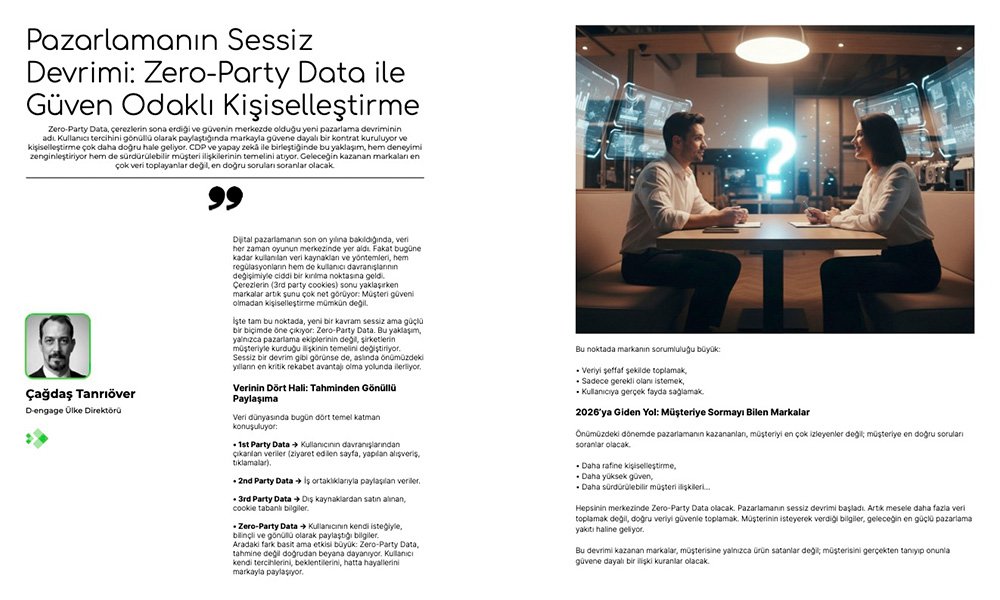
By Çağdaş Tanrıöver, Country Director at Dengage — wrote for Fintechtime, October Issue: “The Silent Revolution of Marketing: Trust-Driven Personalisation through Zero-Party Data.”
“Zero-Party Data is the name of the new marketing revolution where cookies come to an end and trust takes center stage.
When a user voluntarily shares their preferences, a trust-based contract is established between the brand and the individual — enabling far more accurate personalisation.
Combined with a Customer Data Platform (CDP) and artificial intelligence, this approach enriches experiences and lays the foundation for sustainable customer relationships.
The winning brands of the future will not be those collecting the most data, but those asking the right questions.”
A Silent Revolution in Marketing
Looking back at the last decade of digital marketing, data has always been at the heart of the game.
However, the sources and methods used to collect and leverage that data have reached a breaking point — driven by both regulatory changes and evolving consumer behaviour.
As the era of third-party cookies comes to an end, brands have begun to realise a critical truth:
Personalisation is impossible without customer trust.
At this crossroads, a new concept is emerging quietly yet powerfully — Zero-Party Data.
This approach transforms not only how marketing teams operate but also the very foundation of how companies build relationships with their customers.
It may appear subtle, but it’s quickly becoming one of the most decisive competitive advantages of the years ahead.
The Four Faces of Data: From Assumption to Voluntary Sharing
In today’s data ecosystem, we can distinguish four fundamental layers:
- 1st-Party Data → Data derived from user behaviour (pages visited, purchases made, clicks, etc.)
- 2nd-Party Data → Data shared through partnerships or collaborations
- 3rd-Party Data → Cookie-based data purchased from external sources
- Zero-Party Data → Data consciously and voluntarily shared by the user themselves
The difference seems simple, but its impact is profound:
Zero-Party Data is based on declaration, not inference.
Users share their preferences, expectations — even their aspirations — directly with the brand.
Why It’s a Game-Changer
Explaining the rise of Zero-Party Data solely through regulation would be incomplete.
While laws like KVKK (Turkey’s Personal Data Protection Law) and GDPR (General Data Protection Regulation) have indeed narrowed the paths for data collection, the real driver is the shift in customer mindset.
Today’s users:
- Demand experiences they can control
- Expect transparency
- Seek tangible value in return
Research shows that consumers view a brand’s clarity on how it uses personal data as the single most critical factor of trust.
In other words, to obtain data from customers, brands must first earn their trust.
Zero-Party Data therefore acts as a new social contract in marketing:
“I tell you my preferences; in return, you offer me a personalised and valuable experience.”
Real-World Applications in Fintech and E-Commerce
Imagine a fintech company asking its customers a simple question:
“Is your current priority saving or investing?”
Even this brief response allows the company to personalise all offers behind the scenes.
Users focused on saving receive tailored savings plans, while those preferring investments are presented with relevant fund recommendations.
Similarly, an e-commerce brand might ask:
“Which brands would you like to see?”
Once this preference is integrated into the product recommendation engine, both customer satisfaction and conversion rates rise significantly.
According to McKinsey’s 2023 report, brands that implement effective personalisation strategies achieve up to 40% additional revenue growth.
Zero-Party Data becomes the most reliable fuel for that personalisation.
Designing Experiences with the Customer
The most defining aspect of Zero-Party Data is that it turns the customer from a passive target into an active participant.
Consider a banking app that asks a new customer upon opening an account:
“This year, is your main goal to save more or to explore new investment opportunities?”
That one question can shape an entire long-term relationship.
The user’s response is recorded instantly, tested in small audience groups, and iteratively refined through behavioural feedback.
In this model, the brand designs personalisation not based on assumptions, but on the customer’s explicit input — and the customer sees themselves as part of the process.
The outcome:
Stronger trust, more accurate offers, and a mutually valuable relationship.
The Technology Layer: Amplifying the Revolution with CDP
Zero-Party Data is inherently valuable — yet fragmented.
Its real power emerges when combined with a Customer Data Platform (CDP).
For example, when a user selects “investment” in a form, that information flows into the CDP.
An AI-powered segmentation engine then connects this intent with other behavioural signals and delivers a real-time, context-relevant offer.
Thanks to solutions like Remote Source, this data doesn’t need to be copied or moved — it can be used “when and where it’s needed.”
This approach enhances both data security and operational efficiency.
Platforms like Dengage make this integration possible, enabling brands to achieve trust-based personalisation and real-time marketing agility simultaneously.
The Silent Revolution Is, in Fact, a Trust Agreement
What makes Zero-Party Data so valuable is the trust a customer places in the brand.
When users voluntarily share their preferences, they are essentially saying:
“You know my expectations — act accordingly.”
That trust comes with major responsibilities for brands:
- Collect data transparently
- Request only what is necessary
- Deliver genuine value in return
The Road to 2026: The Brands That Know How to Ask
In the coming years, the winners of marketing will not be those tracking customers the most — but those asking them the right questions.
- More refined personalisation
- Higher trust
- More sustainable customer relationships
At the heart of all these lies Zero-Party Data.
The silent revolution of marketing has begun — and it’s no longer about gathering more data, but gathering the right data, responsibly.
The brands that will thrive in this new era are not those merely selling products,
but those that truly know their customers and build trust-driven relationships with them.