


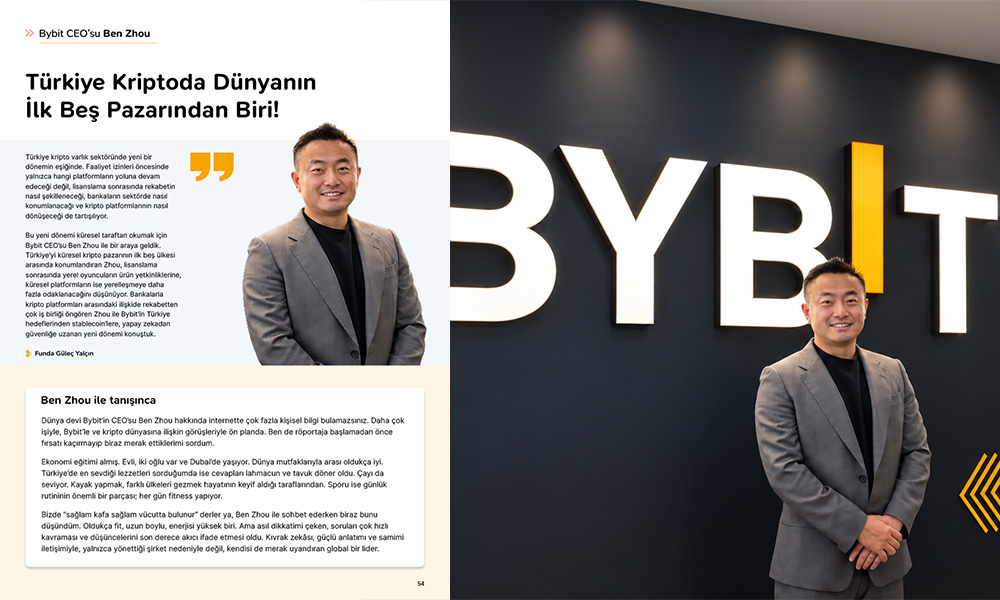
Our interview with Bybit CEO Ben Zhou for Fintechtime’s October issue is now live.
Türkiye’s crypto asset sector is on the threshold of a new era. Ahead of the authorization process, the debate is no longer only about which platforms will continue operating, but also about how competition will take shape after licensing, how banks will position themselves in the sector, and how crypto platforms will evolve.
To view this new era from a global perspective, we sat down with Bybit CEO Ben Zhou. Zhou, who places Türkiye among the world’s top five crypto markets, believes that after licensing, local players will focus more on product capabilities while global platforms will place greater emphasis on localization. With Zhou, who expects cooperation rather than competition to define the relationship between banks and crypto platforms, we discussed the new era spanning Bybit’s ambitions in Türkiye, stablecoins, artificial intelligence and security.
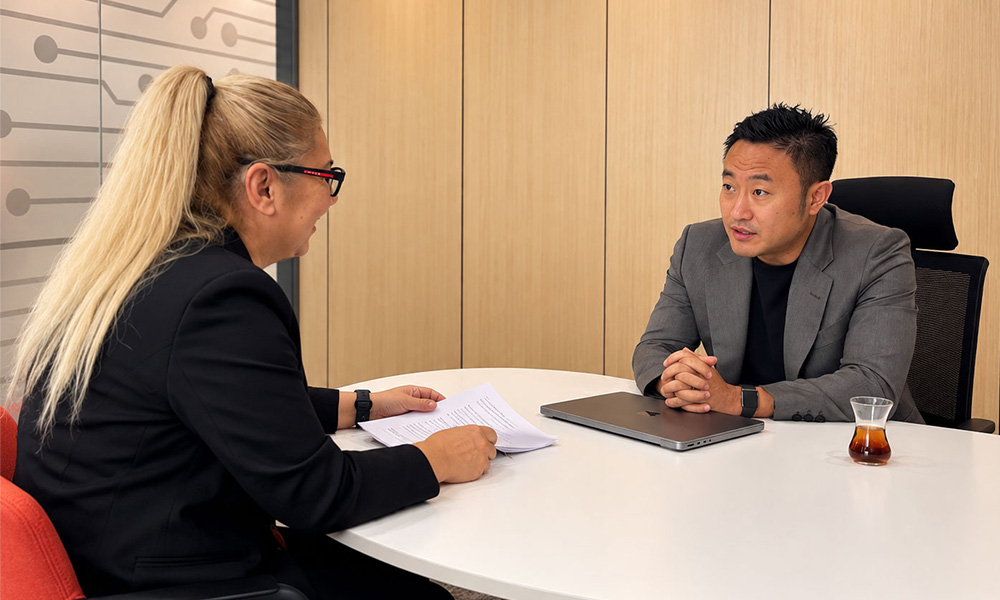
Meeting Ben Zhou
You will not find much personal information online about Ben Zhou, CEO of global giant Bybit. He is known primarily for his work, Bybit and his views on the crypto world. So before we began the interview, I took the opportunity to ask him a few things I was curious about.
He studied economics. He is married, has two sons and lives in Dubai. He has a good relationship with cuisines from around the world. When I asked about his favorite foods in Türkiye, his answers were lahmacun and chicken doner. He also likes tea. Skiing and traveling to different countries are among the things he enjoys in life. Exercise is an important part of his daily routine; he works out every day.
In Türkiye, we have a saying: “A sound mind in a sound body.” Talking with Ben Zhou made me think of exactly that. He is very fit, tall and full of energy. But what struck me most was how quickly he grasps questions and how fluently he expresses his thoughts. With his quick mind, strong communication skills and warm manner, he is an intriguing global leader not only because of the company he runs, but also in his own right.
I have been following Bybit for quite a long time. It is fascinating to see how the company has changed. You started as a crypto exchange, but today you are talking about a new financial platform.
Yes. We started in 2018, and it has now been almost eight years. I think everyone in the industry started out as a crypto exchange focused solely on crypto. But the industry and blockchain technology have evolved over time.
Today, first of all, we are seeing many countries begin to regulate blockchain and crypto as an asset class, and stablecoins as a form of money.
In the European Union, we are fully licensed in Europe. The biggest trend and topic there is tokenization, particularly the tokenization of traditional assets and bringing them on-chain.
When I look at Türkiye, I think the country is still at the beginning of its crypto regulatory journey. At the moment, the focus is largely on crypto exchanges. I would say anti-money laundering, know-your-customer processes and sanctions controls are at the forefront.
“The Next Step for Türkiye Is to Connect Its Economy to the World Through Blockchain”
Türkiye’s next stage, I think, could be about how to use crypto and blockchain to connect the Turkish economy to the world. That could allow tokenization, stablecoins and the benefits they offer to come into play.
As the technology and the industry evolve, we are also moving beyond being a company focused only on crypto. Today, a crypto exchange also serves as an infrastructure through which our clients can transfer money and value globally.
“Crypto Exchanges Are No Longer Only About Crypto”
They are even being used for payments. For example, our users in Brazil and Southeast Asia use Bybit to make payments and purchases. They can do this much faster than through other payment networks.
At the same time, users in countries such as Nigeria or Indonesia can now access traditional assets in the same way as people in New York or London. That was not the case before.
So I think the technology is evolving, and crypto exchanges are evolving along with it.
I also saw your new “Make Your Move” campaign. I think it reflects this transformation very clearly. I know you came from the forex world before crypto. So you have actually seen both worlds change, haven’t you?
Yes, that’s correct.
I think the biggest change today is this: years ago, and to some extent even now, when people think about money and what they can do with it, they divide those activities across different apps, different software and different purposes.
When you think about where to keep your money, you think of a bank, right? When you want to invest, you go to another app, perhaps a forex or stock-trading app. When you want to buy crypto, you use another app. And when you want to make a payment, you may need yet another app, such as PayPal.
So all of these things are separated from one another.
But I think crypto and new technologies are beginning to change that.
“The World Is Moving Toward a Single Money App”
Now everyone is trying to bring all of these things together in one place. That is what crypto companies are doing, and that is what banks are doing.
This is why a new concept called the “neobank” has emerged. Even when you look at Revolut, you can see that it offers many different services.
I think globally everyone is moving toward a “single money app” model. We are talking about a structure in which everything you can do with money will be available within one app.
That is the direction we are seeing.
What role does Türkiye play in Bybit’s global growth strategy? Do you see Türkiye only as a strong user market, or also as a potential strategic hub?
If you ask any global crypto exchange, Türkiye is definitely among the top five markets. There are several reasons for this.
Türkiye is a young and developing economy. We see crypto adoption happening faster in emerging economies because the population is much younger and people are more willing to try new things that can offer them greater and better opportunities. That is the first reason.
Second, trust in the established financial system may not be as strong as it is in more developed markets such as the United States. As a result, people adopt new technologies more quickly.
Another factor that differentiates Türkiye is its experience with inflation. As a result, crypto adoption in Türkiye has reached quite high levels.
“Türkiye’s Position Between East and West Sets It Apart”
In addition to all these factors, Türkiye physically connects East and West.
It occupies a very unique position in terms of commerce, forex and different types of trading activity.
All of this probably makes Türkiye one of the world’s leading countries for crypto.
I think this is also one of the reasons why the country and its regulators have begun regulating this technology and the industry.
Türkiye’s crypto industry is preparing for a new regulatory era. What are the most important lessons from Bybit’s regulatory experience in other markets that could also be relevant to Türkiye?
From where we stand today, we can say that regulation in Türkiye is still at a relatively early stage. Crypto platforms are applying for licenses, and we are moving toward a licensed regime.
From what we have observed so far, regulators place a great deal of importance on anti-money laundering and sanctions controls. They want to ensure that the industry grows in a compliant way. That is one of the strongest messages we have received.
We can also see that regulators place a great deal of importance on security.
“Secure Infrastructure First, Innovation Next”
There is a strong emphasis on local control and local security. I think protecting retail users is one of the most important issues here.
This approach is largely aligned with the regulatory approaches we have seen in the European Union and other markets.
I think this foundation needs to be built first. Once that foundation is in place, we can start talking about innovation on top of it. We agree with that approach.
Once the licensing process is completed, in which areas do you expect competition among crypto platforms in Türkiye to change most significantly?
Türkiye has major global players such as Binance, OKX and Bybit. At the same time, you have two very strong local players, Paribu and BtcTurk.
I think the licensing framework will bring these two sides closer together.
At the moment, local players are more focused on on- and off-ramps between the Turkish lira and crypto, while global players focus more on product innovation.
With the licensing framework in place, I think local players will be encouraged to focus more on product capabilities, while international players will place greater emphasis on localization.
Ultimately, competition will increase.
The benefit for local users will be better pricing and better products. I think that is a positive development for everyone here.
Technology and scale provide major advantages for a global platform, while regulation, banking infrastructure and user behavior remain local. In which areas does Bybit believe strong localization is particularly important in Türkiye?

We believe globalization comes through localization. To become global, you need to focus much more on the local market.
You can see this in our model. We have an office here and local employees.
We trust the expertise of our local team. They tell us which deposit and withdrawal methods are useful for users and how the product should look and feel.
The Bybit TR product looks quite different from the global Bybit product because what local users care about is very different from what global clients care about.
At the same time, we need to make sure local users have the best possible customer support.
If they need anything, they should be able to reach us.
All of this localization is absolutely necessary. I think it is one of the keys to gaining market share and growing locally.
As Turkish banks become increasingly involved in crypto asset custody, traditional finance and crypto are moving closer together. Do you expect banks and crypto platforms to become stronger competitors, or will partnerships between the two become more important?
We strongly believe in partnerships.
We have seen this in different parts of the world. We work with banks more than we compete with them because we actually serve different purposes.
Clients may turn to crypto when they want to invest or carry out certain transactions, but they still need a bank.
Banks also need crypto companies for infrastructure support. Banks typically do not have the technology required for custody, liquidity and many other crypto-related products.
So we can work with banks as a kind of technology provider, offering them liquidity, custody solutions and similar services.
So far, globally, we have seen far more synergy and collaboration than competition.
Bybit is positioning itself not simply as a crypto exchange, but as a broader financial platform. Over the next few years, what will be the key factor that differentiates Bybit from a traditional crypto exchange?
When you talk about a traditional crypto exchange, the product offering is limited to crypto.
We are now expanding our product range into non-crypto assets as well, including areas such as stocks, options and, more recently, prediction markets.
We will continue to expand our product offering in the future. As we obtain more licenses, we will be able to offer clients not only crypto, but other products as well.
However, in terms of our long-term strategy, crypto is still in our DNA. Crypto remains at the center of our innovation.
That is why I think we will see many more crypto products in the future that resemble traditional financial products.
Today, for example, if you go to a private bank, you can find many different variations of ETFs, ETPs and other assets.
There are different asset classes such as stocks, commodities and forex.
I think crypto will similarly divide into different subclasses over time and gain more liquidity as the market grows.
Our job is to develop these products and innovate.
Stablecoins, tokenization and real-world assets are changing the boundaries between crypto and traditional finance. What role could Türkiye play in this transformation?
I have not seen many real-world asset stories coming out of Türkiye so far.
But I do see stablecoins being used quite extensively for cross-border payments, especially by businesses.
Türkiye is probably one of the world’s largest users of stablecoins for institutional B2B cross-border payments.
Retail users also like to use stablecoins for many different purposes. So I see a great deal of usage in this area.
But when it comes to tokenization and real-world assets, I think we need to wait for regulation. At the moment, regulation is focused more on crypto exchanges. It has not yet moved into these other areas.
With Bybit AI, artificial intelligence is becoming a direct part of trading and the customer experience. If AI becomes the primary interface between users and financial platforms, how will the crypto investment experience change? How should user control and risk management be preserved?
That’s a good question.
Artificial intelligence is one of the latest developments, and we are also giving our clients tools that allow them to use AI.
Today, however, we position AI more as an assistive tool. For any transaction to be executed, the client needs to provide the final authorization and confirmation.
So far, we have not seen many users using AI to fully automate payments.
But what we see in the future is “agentic payment,” meaning payments carried out by AI agents.
If, in the future, we have AI agents that operate autonomously, purchase services and interact with the real world on behalf of people, I think crypto could become the currency of AI.
That is one of the reasons why people have such high expectations for crypto.
“Crypto Could Become the Currency of AI”
Crypto could become the underlying infrastructure for payments carried out by AI agents.
But for that to happen, many layers of security need to be built.
I think we are still at a very early stage. Before a transaction takes place, exchanges still require authorization from the user — in other words, prior approval.
And the challenge is not only technological. The legal system is not ready for this yet either.
For example, if an AI agent makes a payment and the user later wants to reverse that payment with the merchant, what happens?
“The Legal Infrastructure Is Not Yet Ready for Large Transactions”
How do you determine who made the decision? Who bears responsibility and ownership?
So I think this area is still at an extremely early stage.
Of course, we are right to question security and be concerned about it. But from my perspective, we are still some way from seeing these kinds of transactions happen at scale.
The main reason is that the legal framework required for large transactions has not yet been established.
Small transactions may be possible. But when it comes to larger transactions, much more infrastructure needs to be built.
That includes crypto exchanges, lawmakers and regulations.
I think that process has started. We are definitely moving in that direction.
The major security incident in February 2025 was an important test for Bybit. Looking back today, what did that experience permanently change in your approach to security, governance and third-party risk?
What lessons could markets such as Türkiye, where crypto asset custody infrastructure is still evolving, draw from that experience?
That’s also a good question.
I think this is one of the reasons why Turkish regulators place so much emphasis on security, segregation of assets, and separating local structures from global ones.
If an incident like this occurs, the local structure should not be affected and local users should be protected.
We think this is one of the areas Turkish regulators are focusing on most. I appreciate their focus on this, and I think it is the right direction.
Under the current regulations, everything needs to be structured locally within Türkiye. That includes cold wallets, hot wallets and control of the wallets.
“We Now Operate a Zero-Trust Policy”
The aim is to ensure that an incident occurring globally does not affect the local structure.
Looking back at the incident we experienced — and there have been many other incidents in the industry since then — I think one of the key lessons is to spread the risk.
You should not put all your eggs in one basket.
One of the reasons for the incident at Bybit was the third-party service provider we were using, and we had too many assets with that third party.
In retrospect, we have completely changed our policy.
We now operate a “zero trust” policy.
At the same time, we are working to divide our wallets across different structures and segregate them at both local and global levels. This is intended to prevent a single attack from affecting a very large amount of assets.
That is the model we are following now.
Looking three to five years ahead, what would a successful Bybit in Türkiye look like? What are your ambitions in terms of products, local teams, partnerships and institutional clients?
Today, we have a certain number of retail clients in Türkiye. But I cannot say that we are yet deeply integrated into Turkish society and institutions.
In the future, I hope we can serve not only retail clients, but a much broader user base and institutional clients as well.
“We Want to Turn Bybit into a Super App in Türkiye”
At the same time, we want to expand our product offering and turn Bybit into a true “super app” that our clients can use.
For that reason, we may begin looking at other licenses we could obtain in Türkiye to complete our product line.
Our goal is for more retail and institutional users to use Bybit to solve their day-to-day needs.
That need could be a global money transfer, a stablecoin payment, or access to a particular investment product they otherwise could not access.
Bybit’s goal is to open up a world of global financial opportunities to local users.
That could be an opportunity in Hong Kong, an opportunity in the United States, or even bringing a high-quality local Turkish asset to the global stage.
That is our advantage.
And that is exactly what we hope to achieve in Türkiye.